
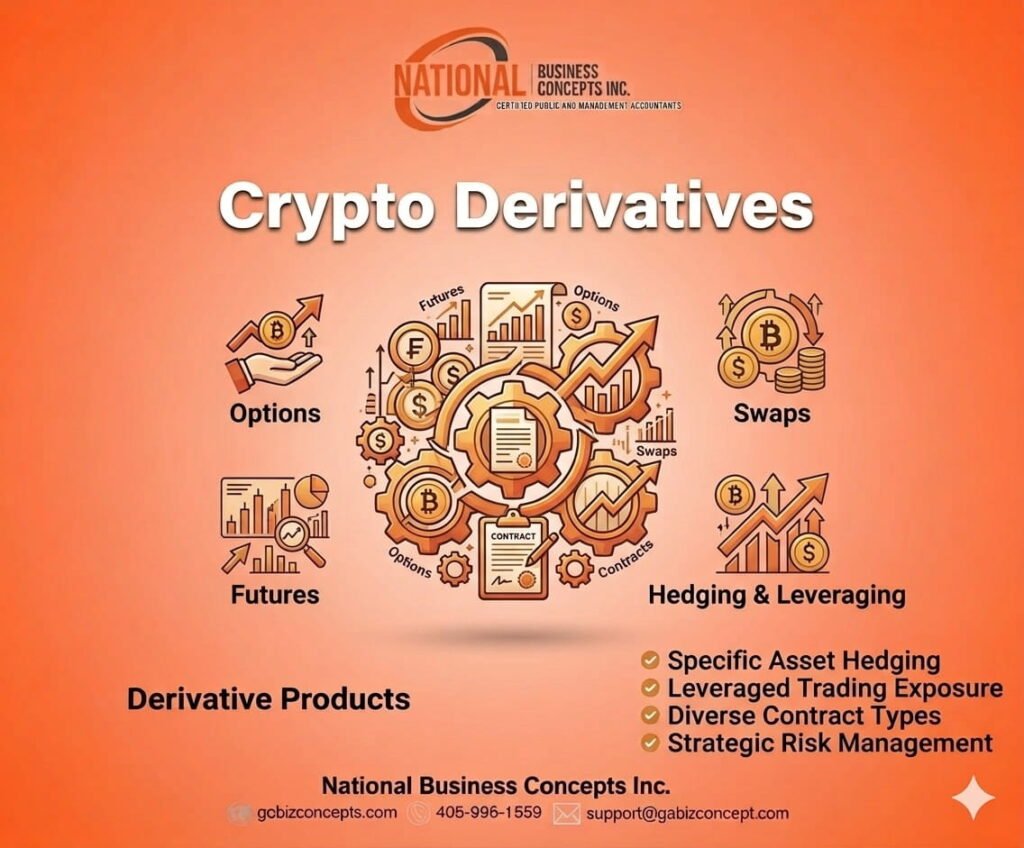
Crypto derivatives, like fiat derivatives, are financial contracts whose values are derived from underlying volatile assets, in this case, cryptocurrencies. They are widely used for speculation, hedging, and leveraged exposure to markets and risks. In these instruments, ownership of the actual digital asset is not required, as trading is conducted on exchanges through agreements based on price movements. Futures contracts are structured to obligate parties to buy or sell assets at predetermined prices on set dates, while perpetual swaps are designed to function like futures but without expiry, maintained through funding rates. Options contracts are created to grant rights, without obligations, to buy or sell assets at agreed prices before expiration. In the USA, derivatives are regulated by several regulators
Crypto Derivatives Vs. Fiat Denominated Derivatives
Again, crypto derivatives are contracts whose value is derived from cryptocurrencies, while fiat-denominated derivatives are contracts based on traditional assets such as commodities, equities, or currencies. In both cases, speculation, hedging, leverage, and exposure to hard-to-trade assets or markets are facilitated, but the underlying markets differ in volatility and maturity. Crypto derivatives are mainly characterized by perpetual swaps, futures, and options tied to digital assets, often traded on exchanges with evolving oversight. Fiat derivatives, by contrast, are structured around established instruments like interest rate swaps, commodity futures, and equity options, governed by long-standing regulatory frameworks. Similar mechanisms of leverage and risk transfer are employed, yet crypto derivatives are distinguished by higher volatility, nascent regulation, and technological dependence.
Crypto Derivatives Denomination
Crypto derivatives contracts commonly employ cryptocurrencies with sufficient liquidity, volatility, and trading volume to support robust markets. Therefore, Bitcoin (BTC) futures are widely traded, allowing speculation on BTC’s price without direct ownership, while Ethereum (ETH) options are structured to provide rights to buy or sell ETH at predetermined prices. Solana and Ripple have been increasingly adopted in perpetual swaps and futures because of their growing ecosystems and active trading communities. Litecoin and other established altcoins are occasionally included, though their derivative markets are smaller in comparison. In practice, the dominance of Bitcoin and Ethereum ensures that most derivative products are denominated in these assets, while select altcoins are incorporated to diversify exposure and meet demand for broader speculative opportunities.
Crypto Derivatives Exchanges
Internet technologies make crypto derivatives available worldwide. However, in the U.S., regulated crypto derivatives exchanges, i.e., on DeFi platforms, include CME Group, Coinbase Derivatives, Kraken Futures, and Bitnomial. They are all overseen by the Commodity Futures Trading Commission (CFTC). Offshore, unregulated platforms such as Binance, Bybit, OKX, KuCoin, and Bitget dominate global trading but operate outside U.S. jurisdiction.
Example With Crypto Call and Put Options
As an example, for an investor to sell a crypto call option, he/she must first fund their crypto account, satisfying any margin requirements. After this, an order to write or sell an option contract is entered on a chosen exchange or trading platform. The strike price and expiration date are selected, and the premium to be received is determined by prevailing market conditions. Once the order is executed, the seller is obligated to deliver the underlying asset if the option is exercised by the buyer. The premium is credited to the seller’s account, and ongoing monitoring is required to manage margin calls, potential assignment, and market exposure until the option expires or is closed through a buyback transaction.
Likewise, the sale of a put option follows almost the same procedural steps as described for the sale of a call. But when a put option is sold, the investor agrees to buy the underlying asset at the strike price if exercised, and the premium is credited upon execution. When a put option is purchased, the right to sell the asset at the strike price is obtained, and the premium is paid to the seller. The strike price and expiration date are selected, the order is executed, and ongoing monitoring is required to manage exposure, margin obligations, and potential assignment until expiration or closure.
Crypto Derivatives Risks
Crypto derivatives are associated with significant risks, as high volatility in cryptocurrency markets can cause rapid price swings and magnified losses when leverage is employed. Margin calls (a demand of an investor for further deposit to meet a minimum account amount) are frequently triggered, and liquidation risks are heightened due to sudden market movements. Regulatory uncertainty contributes to risk, since oversight varies across jurisdictions, leaving traders exposed to legal and compliance challenges. Counterparty risk is introduced when centralized exchanges are involved, while smart contract vulnerabilities can affect decentralized platforms. Liquidity risks may arise in smaller markets, where positions cannot be exited efficiently. Overall, exposure to crypto derivatives is characterized by amplified financial risk, technological dependence, and evolving regulatory frameworks.
Crypto Derivatives Regulation
Crypto derivatives, and financial derivatives in general, in the United States are regulated through a multi-agency framework in which the Commodity Futures Trading Commission (CFTC) oversees futures, options, and swaps as commodities under the Commodity Exchange Act, while the Securities and Exchange Commission (SEC) supervises derivatives tied to crypto assets classified as securities. The Internal Revenue Service (IRS) enforces tax reporting and compliance obligations, ensuring that gains and losses from derivative trading are properly declared. The Office of the Comptroller of the Currency (OCC) provides guidance for banks engaging with crypto-related activities, including custody and settlement services. The Financial Crimes Enforcement Network (FinCEN) enforces anti-money laundering and know-your-customer rules, requiring exchanges and intermediaries to register and report suspicious activities.
Conclusion
Crypto derivatives are financial contracts whose values are tied to cryptocurrencies, enabling speculation, hedging, and leveraged exposure like fiat derivatives. Unlike traditional derivatives based on commodities or equities, crypto derivatives rely on volatile digital assets such as Bitcoin and Ethereum, chosen for liquidity and trading volume. Derivatives, such as futures and options, allow speculation without direct ownership, while internet platforms provide global access. In the U.S., regulated exchanges operate under multi-agency oversight. However, risks remain significant, as volatility and leverage can magnify losses. Overall, crypto derivatives mirror traditional derivatives in purpose but differ in underlying assets, market maturity, and regulatory complexity.
NB: This article is for informational purposes only and does not pretend to give investment or financial advice.
Richard Thomas
