
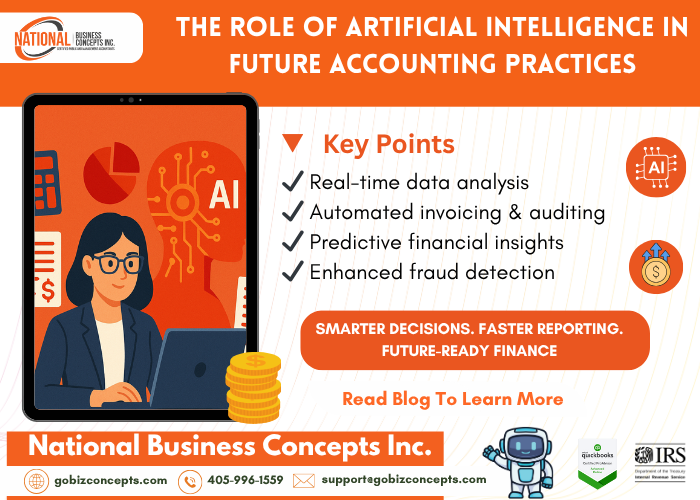
Generative artificial intelligence (AI) has found numerous roles in various industries, occupations, and professions. The prognosis for artificial intelligence in accounting practices is similarly significant.
In general, generative AI can perform analysis tasks, make decisions, provide insights and recommendations, predict outcomes, and generate original datasets or business processes. It has proven valuable in describing products, suggesting design variations, and examining different concepts. Additionally, it is proficient in natural language processing and generation, translation, and can serve as a foundation for automating routine tasks, such as data entry, table formatting, and other data preparation activities, including data extraction, cleaning, integration (combining data from different sources for a unified view), and transformation (conversion of data from one format to another). Moreover, it can facilitate invoice processing, produce summaries, and enhance the accuracy and reliability of reports by reducing errors and minimizing human error and bias.
Beyond audit and risk assessment, the accounting cycle offers numerous opportunities to leverage the capabilities of generative AI. To begin, it is essential to understand what constitutes the “Accounting Cycle.”
Accounting Cycle
The accounting cycle, as delineated by the Generally Accepted Accounting Principles (GAAP) accounting cycle, is a structured procedure for recording, summarizing, and reporting financial transactions. The GAAP accounting cycle aims to ensure that financial statements are accurate, consistent, and reliable, thereby fostering transparency and trust among stakeholders. Its steps include the analysis of source documents, recording of financial transactions in journals. posting the relevant transactions to a ledger, preparation of trial balances, preparation of financial statements, and the analysis of financial ratios.
Preparatory Steps For Use Of Artificial Intelligence In Accounting Practices
The use of AI in the accounting cycle presumes that source documents have been scanned or otherwise digitized; Its use also anticipates that the AI system is integrated, through application programming interfaces (API), with the main databases or Enterprise Resource Planning (ERP) system. The integration allows AI to access real-time ledger structures (e.g., chart of accounts,) submit entries programmatically with proper authentication, validate transactions against existing data constraints, and log audit trails for compliance and traceability. This arrangement ensures seamless and secure data flow while maintaining GAAP-aligned control and documentation. Also, it helps reduce human error and accelerates reporting, supporting timely and compliant financial disclosure for stakeholders.
Role Of Artificial Intelligence In Analysing Source Documents
The step, “Analyse Source Documents” involves reviewing, categorizing, verifying, documenting, and preparing original financial documents for journal entry. AI can enhance the analysis of source documents—like invoices, receipts, and contracts—by automating data extraction, classification, and validation. Using natural language processing (NLP) and machine learning, AI systems can: Extract key data (e.g., amounts, dates, vendor names); classify documents into appropriate categories (e.g., revenue, expenses, assets); cross-check entries for compliance with GAAP principles; and flag anomalies such as duplicate invoices or unusual amounts for further review.
Role Of Artificial Intelligence In Record transactions in journals
Formally, the GAAP accounting cycle begins with the recording of financial transactions as journal entries in the general journal, using the double-entry system, ensuring accuracy and balance. Each transaction affects at least two accounts, with one debited and the other credited, maintaining the equation Assets = Liabilities + Equity. Entries include the transaction date, affected accounts, amounts, and a brief description. AI can assist in recording transactions in journals, after the analysis of source documents, by automatically capturing financial data and classifying entries based on predefined rules. It applies natural language processing to interpret content, identify debit and credit accounts, and posts entries into the appropriate journals. It can also validate transactions against accounting standards and flag inconsistencies. Its use reduces manual input, improves accuracy, and accelerates the bookkeeping process.
Role Of Artificial Intelligence In Considering Adjusting Entries
Some financial transactions may not have a physical source document but must still be recorded in journal entries. So, consideration must be given to “adjusting entries” or “non-source transactions,” also known as “internal transactions.” AI can consider adjusting entries by analysing transactional patterns, flagging discrepancies, noting estimates, and predicting necessary accruals or deferrals. It can identify mismatches between recorded revenues or expenses and actual timing, using historical data and rules-based logic. For example, AI may suggest adjusting entries for prepaid expenses, amortization, depreciation, or accrued liabilities. This enhances accuracy and ensures compliance with the matching principle, reducing the risk of omission or misstatement before closing entries are finalized.
Role Of Artificial Intelligence In Posting to the Ledger
According to the GAAP accounting cycle, the ledger posting step involves transferring journal entries from the general journal to the corresponding general ledger accounts. AI streamlines posting to the ledger by transferring verified journal entries, with precision and speed, into the general ledger. Leveraging automation, it ensures each debit and credit is mapped to the correct account, checks for balance integrity, and reduces risks of human error. AI can also link entries to source documents for traceability and continuously monitor for anomalies or rule violations. This accelerates the transition from transaction recording to trial balance preparation
Role Of Artificial Intelligence In Preparation Of Trial Balances
Preparing a trial balance involves listing all ledger account balances at a specific point in time to ensure that total debits equal total credits. This step checks for mathematical accuracy in double-entry bookkeeping before adjusting entries are made. AI facilitates the preparation of trial balances by aggregating posted ledger entries and automatically summing debits and credits to ensure balance. It flags discrepancies, missing entries, or inconsistencies in account totals. AI can also detect patterns that indicate common posting errors and suggest corrections. By continuously reconciling data and applying predefined rules, it produces accurate trial balances faster, reducing manual oversight and paving the way for reliable financial statement preparation.
Role Of Artificial Intelligence In Preparation Of Financial Statements
In the GAAP accounting cycle, the preparation of financial statements involves using the adjusted trial balance to create structured reports: the income statement, balance sheet, statement of retained earnings, and cash flow statement. AI can aid in the preparation of financial statements by transforming the adjusted trial balance into standardized reports like the income statement, balance sheet, and cash flow statement. It automates formatting, ensures data consistency across statements, and applies GAAP rules for classification and disclosure. AI can also generate draft narratives, flag anomalies, and suggest corrections before finalization.
Role Of Artificial Intelligence In The Analysis Of Financial Ratios
Even though GAAP does not mandate ratio analysis, analysis of financial ratios involves evaluating relationships among financial data to assess a company’s performance, liquidity, solvency, and profitability. Common ratios include the current ratio, debt-to-equity ratio, and return on equity. AI enhances financial ratios analysis by rapidly calculating and interpreting key metrics—like liquidity, profitability, and solvency—from finalized financial statements. It can benchmark ratios against industry standards, highlight trends, and detect anomalies over time. AI-driven dashboards can visualize results and provide predictive insights, aiding strategic decisions.
Conclusions
AI is poised to transform accounting by streamlining every phase of the GAAP accounting cycle. Beyond audit and risk assessment, generative AI supports tasks like data extraction, classification, prediction, and report generation. It automates routine processes such as journal entries, ledger posting, trial balance preparation, and financial statement creation. By integrating with ERP systems and relying on digitized source documents, AI ensures greater speed, accuracy, and consistency. It also aids in analysing financial ratios and adjusting entries by detecting patterns and forecasting accruals. Ultimately, AI enhances efficiency and reliability while upholding GAAP principles of transparency and trust.
Richard Thomas
Previous: AI Use in Accounting
