
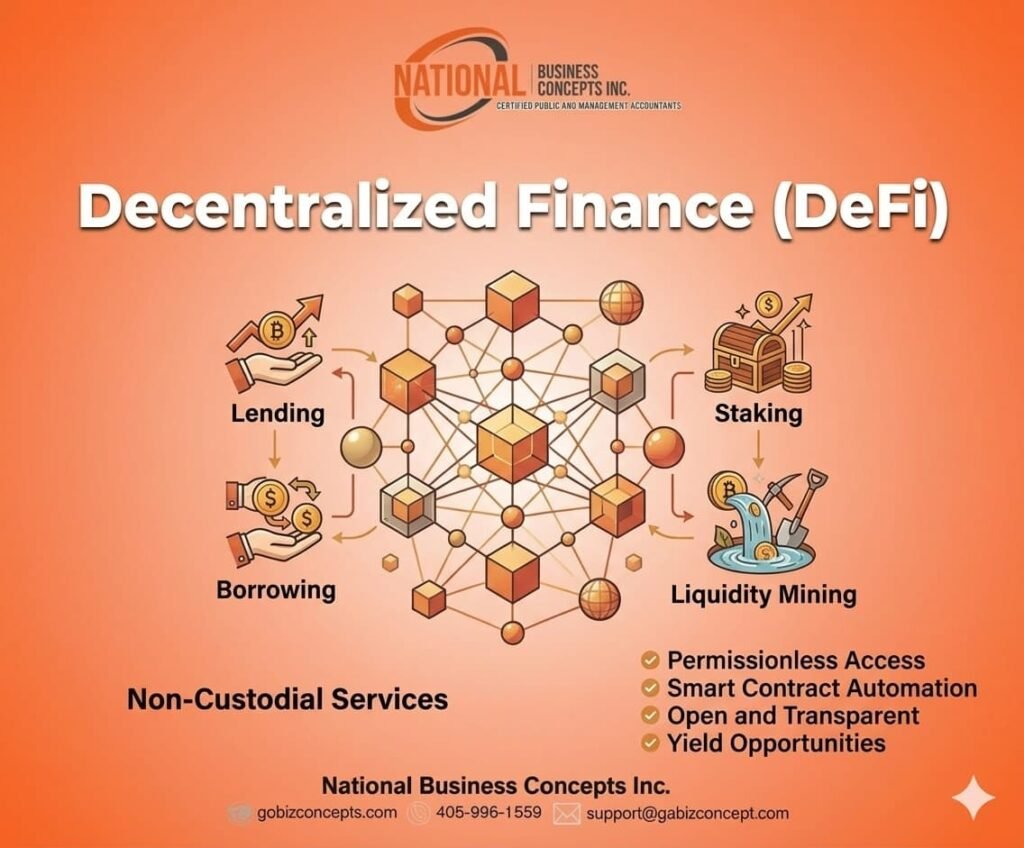
Decentralized Finance (DeFi) has been introduced as a blockchain-based alternative to traditional financial systems, enabling permissionless access to lending, borrowing, trading, and asset management. Cryptocurrency has been utilized as both a medium of exchange and a store of value within this ecosystem, with smart contracts automating transactions and enforcing rules. Loans have been extended through over-collateralized mechanisms, where digital assets are locked to secure borrowed funds. Collateral types have included volatile tokens like ETH and SOL, as well as stablecoins such as USDC and DAI, and Non-US pegged stablecoins. Lending protocols have been designed to adjust interest rates algorithmically, based on real-time supply and demand dynamics, rather than fiat benchmarks.
Token trading has been facilitated by decentralized exchanges, while yield farming and liquidity provision have been incentivized through reward structures. Staking has been employed to secure networks and generate passive income, often through liquid staking derivatives. Synthetic assets and derivatives have been created to mirror traditional instruments, expanding DeFi’s reach into complex financial products. Insurance protocols have been developed to mitigate smart contract risk, and asset management tools have been deployed to optimize portfolio performance. Through these mechanisms, DeFi has been positioned as a modular, transparent, and programmable financial system, offering strategic opportunities for users with varying risk appetites and technical fluency.
Cryptocurrencies On DeFi platforms.
Cryptocurrency is the foundational medium of exchange and collateral within decentralized finance platforms, where assets such as Ethereum (ETH), Bitcoin (BTC), and Solana (SOL) have been locked into smart contracts to secure loans and enable liquidity. Stablecoins like USDC, USDT, DAI, and Non-US pegged stablecoins, such as EURC / EUROe (Euro,) have been adopted to reduce volatility, while governance tokens such as UNI, AAVE, and COMP have been distributed to incentivize participation and voting. Through these media, lending and borrowing are facilitated, interest rates are algorithmically adjusted, and token trading is executed without intermediaries.
Decentralized Finance (DeFi) Loans
DeFi includes loans, algorithmic interest rates, and liquidity provision, where smart contracts are employed to automate transactions without intermediaries. Borrowers are enabled to lock digital assets as collateral, in the form of volatile tokens such as ETH and SOL or stablecoins like USDC and DAI, without requiring the sale of underlying assets, allowing borrowers to unlock value while maintaining exposure to other cryptocurrency holdings. Loans are issued in stablecoins or other tokens, with liquidation triggered when collateral values fall below thresholds. Lending is facilitated through decentralized protocols, where funds are pooled and distributed automatically, and repayment obligations are monitored transparently. Smart contracts enforce over-collateralization, protecting lenders, and lenders are rewarded with algorithmically set interest, based on supply and demand.
Decentralized Finance (DeFi) Platforms Decentralized Exchanges
Decentralized exchanges on DeFi platforms are designed to enable token trading without reliance on centralized intermediaries, with transactions executed through automated market maker protocols. Liquidity pools are established by users who deposit pairs of tokens, and these pools are utilized to facilitate swaps while generating transaction fees for liquidity providers. Stablecoins are used as base pairs to reduce slippage and risk. Alternatively, token trading can be carried out directly between participants, with smart contracts ensuring transparency and efficiency in the process. Yield incentives are distributed to encourage liquidity provision, and governance tokens are allocated to strengthen community participation. Through decentralized exchanges, access to trading has been broadened, liquidity is maintained, and market activity is supported in a fully decentralized manner.
Decentralized Finance (DeFi) Payments And Remittances
Stablecoins have been adopted on DeFi platforms as essential instruments for payments and remittances, where their value has been pegged to fiat currencies such as the U.S. dollar to provide stability in volatile markets. Transactions are executed with tokens like USDC, USDT, and DAI, or Non-US pegged stablecoins, enabling predictable transfers across borders without reliance on traditional banks. Remittances are facilitated by stablecoins, as funds are moved quickly and at lower costs compared to conventional systems.
Decentralized Finance (DeFi) Yield Farming
Yield farming has been implemented on DeFi platforms to incentivize participation and maintain market efficiency. Yield farming is enabled through the distribution of governance tokens and rewards, which are allocated to liquidity providers based on their contributions. As before, liquidity is supplied by users who deposit pairs of tokens into pools. Smart contracts automate the allocation of returns, and strategies are executed to maximize yield by moving assets across multiple pools. Through these mechanisms, liquidity is sustained, token trading is supported, and participants are rewarded for strengthening the decentralized financial ecosystem.
Next time, Decentralized Finance (DeFi) – Part II: staking, derivatives and synthetic assets, insurance and asset management, top decentralized finance (DeFi) platforms, risks, regulations, and conclusion.
NB: This article is for informational purposes only and does not pretend to give investment or financial advice.
By Richard Thomas
