
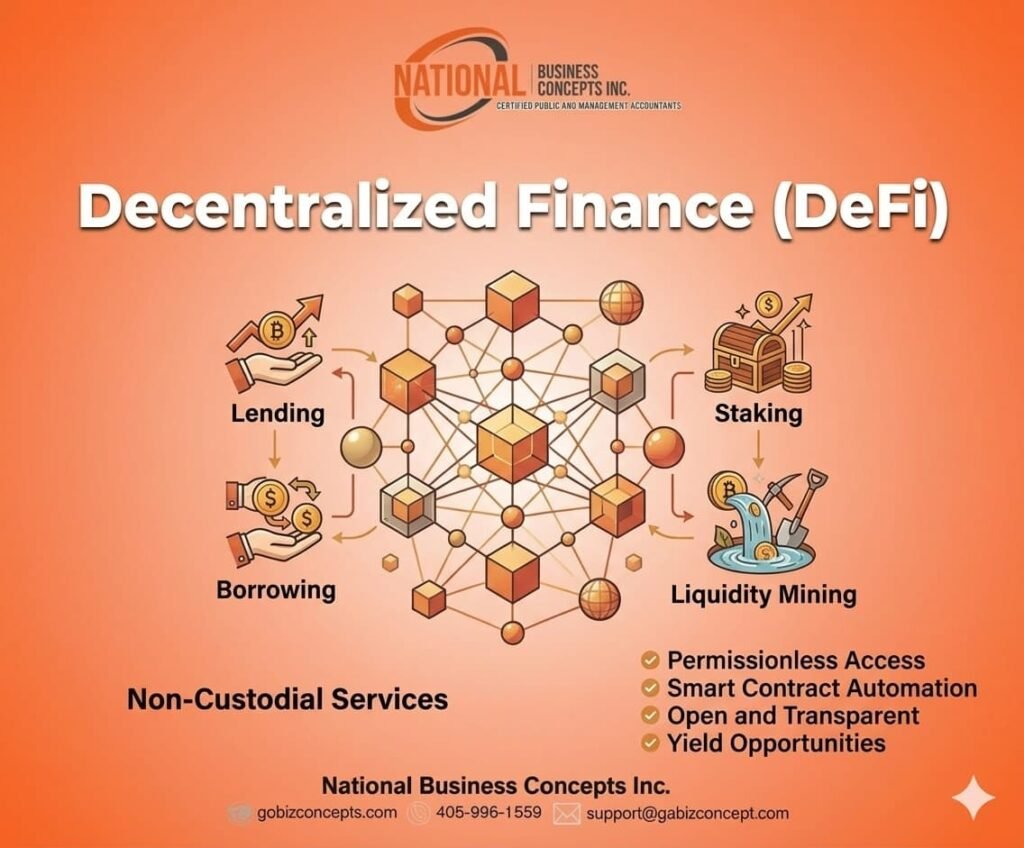
Previously, decentralized finance (DeFi) was introduced beginning with DeFi platforms with their focus on smart contracts and their blockchain corollaries of traditional finance; then continued with the implementation of DeFi loans; DeFi exchanges with their focus on trading various mintages of cryptocurrencies, e.g., BTC, USDC, USDC, ETH, etc.; payment; remittances; and yield farming, the process by which tokens are allocated to liquidity providers based on their contributions. This time, we continue our brief look at DeFi first with platform staking, then derivatives and synthetic assets, followed by insurance and asset management, the top DeFi platforms, DeFi risks, and finally regulations.
Decentralized Finance (DeFi)Platform Staking
Staking on DeFi platforms is a mechanism through which cryptocurrency holders are incentivized to lock their assets in smart contracts to support network security and earn passive income. Tokens such as ETH, SOL, and governance assets are deposited into staking pools, and rewards are distributed in proportion to the amount staked and the duration of participation. Liquid staking derivatives have been introduced, allowing staked assets to remain tradable while continuing to generate yield. In addition, smart contracts have been employed to automate reward allocation and enforce staking rules, while governance rights have been extended to participants. Through these processes, staking is positioned as both a security measure and a yield-generating strategy within DeFi ecosystems.
Derivatives And Synthetic Assets On Decentralized Finance (DeFi)Platforms.
Through innovation and diversification efforts, derivatives and synthetic assets have been introduced on DeFi platforms to replicate traditional financial instruments in a decentralized environment, where exposure to commodities, equities, or fiat currencies is simulated through tokenized contracts. Smart contracts are employed to create synthetic versions of assets, allowing users to gain price exposure without direct ownership. Perpetual futures, options, and leveraged tokens are offered, and collateral is locked to secure these positions. Liquidity pools are utilized to support these trades, while algorithmic mechanisms maintain asset pegs and mitigate risk.
Insurance And Asset Management On Decentralized Finance (DeFi) platforms.
Insurance and asset management have been incorporated into DeFi platforms to provide risk mitigation and portfolio optimization in decentralized environments. Insurance protocols have been established to protect users against smart contract failures, exchange hacks, and liquidity risks, with coverage funded through pooled contributions and automated claim assessments. Asset management tools have been deployed to enable diversified strategies, where portfolios have been rebalanced through customizable liquidity pools and algorithmic mechanisms. Governance tokens have been distributed to participants, allowing collective oversight of insurance and asset management frameworks. These mechanisms have reduced DeFi risks, streamlined investment strategies, and improved transparency.
Top Decentralized Finance (DeFi) Platforms.
The leading DeFi platforms have been recognized for their dominance in lending, trading, staking, and liquidity provision, with Aave and Compound noted for decentralized lending and borrowing, while MakerDAO has been credited with the creation of the DAI stablecoin. Uniswap, Curve Finance, SushiSwap, PancakeSwap, and Balancer have been utilized as decentralized exchanges, where token trading and liquidity pools have been maintained. Lido has been employed for liquid staking, enabling staked assets to remain tradable, while dYdX has been adopted for decentralized derivatives and perpetual contracts.
Risks
DeFi platforms have been associated with several systemic risks that have introduced fragility and must be carefully considered. Smart contract vulnerabilities have been exploited in the past, leading to significant losses, while coding errors have been left uncorrected due to the absence of centralized oversight. Market volatility has been observed to cause rapid declines in collateral value, resulting in forced liquidations and unexpected debt obligations. Liquidity risks have been encountered when pools have been drained or manipulated, leaving users unable to withdraw funds. Governance risks have been introduced through token concentration, where decisions have been influenced by a small group of holders. Until recently, regulatory uncertainty has been imposed on stablecoins and lending protocols, creating potential restrictions or shutdowns.
In the US, after the passage of the GENIUS Act, stricter collateral requirements have been imposed on lenders to ensure systemic stability, as regulators have sought to reduce risks associated with volatile assets and under-collateralized loans. Borrowers have been subjected to enhanced monitoring and reporting obligations, with transaction data and collateral positions scrutinized more closely to enforce compliance. As a result, flexibility in loan issuance has been reduced, and the likelihood of liquidations during market downturns has been increased. In this context, liquidation has not meant loan recall in the traditional banking sense; instead, it has referred to the forced sale of collateral when its value has fallen below required thresholds, ensuring repayment obligations are met through automated smart contracts.
Stricter collateral requirements have been considered a risk for both borrowers and lenders, though the impact has differed. For borrowers, higher collateral thresholds have meant that more assets must be locked to secure loans, reducing capital efficiency and increasing the chance of liquidation during volatility. For lenders, stricter requirements have limited flexibility in issuing loans, as fewer borrowers have been able to meet the elevated standards, thereby reducing lending activity and potential returns. In essence, borrowers have faced reduced accessibility and heightened exposure to liquidation, while lenders have encountered diminished loan demand and constrained portfolio growth. Thus, the risk has been shared across both sides, though manifested differently depending on the role within the DeFi ecosystem.
Regulation
Current laws and regulations applying to DeFi in 2026 have focused on securities classification, know your customer (KYC,) anti-money laundering (AML), stablecoin oversight, and international harmonization, with frameworks such as the EU’s MiCA and U.S. GENIUS Act. See the US regulations of crypto stablecoins.
Conclusion
Decentralized Finance (DeFi) has been introduced as a blockchain-based alternative to traditional financial systems, offering permissionless access to lending, borrowing, trading, and asset management. Cryptocurrencies such as ETH, BTC, and SOL have been locked into smart contracts to secure loans and provide liquidity, while stablecoins like USDC, USDT, DAI, and non‑US pegged options such as EURC have been adopted to reduce volatility. Smart contracts have automated loans, algorithmic interest rates, and liquidity provision, while decentralized exchanges have enabled token trading through automated market maker protocols. Yield farming and staking have been implemented to incentivize participation, with governance tokens distributed to liquidity providers, while synthetic assets and derivatives have replicated traditional instruments in decentralized environments.
Insurance and asset management have also been incorporated into DeFi platforms to mitigate risks and optimize portfolios, with protocols established to protect against smart contract failures, exchange hacks, and liquidity risks. Coverage has been funded through pooled contributions and automated claim assessments, strengthening user confidence. Leading platforms have been recognized for dominance in lending, trading, staking, and liquidity provision, though systemic fragility has been highlighted. In the U.S., after the passage of the GENIUS Act, stricter collateral requirements have been imposed on lenders, reducing flexibility in loan issuance. Borrowers and lenders alike have faced heightened risks, as liquidations during market downturns have become more likely under these regulatory constraints.
NB: This article is for informational purposes only and does not pretend to give investment or financial advice.
Previous: DeFi with Cryptocurrency – Part I
By Richard Thomas
