It is important to implement trustworthy internal controls to prevent fraud in your business. There are many opportunities for internal and external actors to abuse a position of trust and perpetrate various schemes. Possible schemes include but are not limited to, embezzlement (cash skimming) inventory theft, payroll fraud (ghost employees) expense reimbursement fraud, inflated revenue recognition, and understated liabilities. asset overstatement, kickbacks/vendor collusion, bid rigging, phishing & business email compromise, and data theft.
So, internal business controls, in general, are mechanisms, rules, and procedures implemented to ensure the integrity of financial and accounting information and reporting, promote accountability, and, importantly, prevent fraud. Also, they are critical for maintaining compliance with laws and regulations, safeguarding assets, promoting operational effectiveness, and enhancing the efficiency and accuracy of financial reporting.
Key Components Of Trustworthy Internal Controls
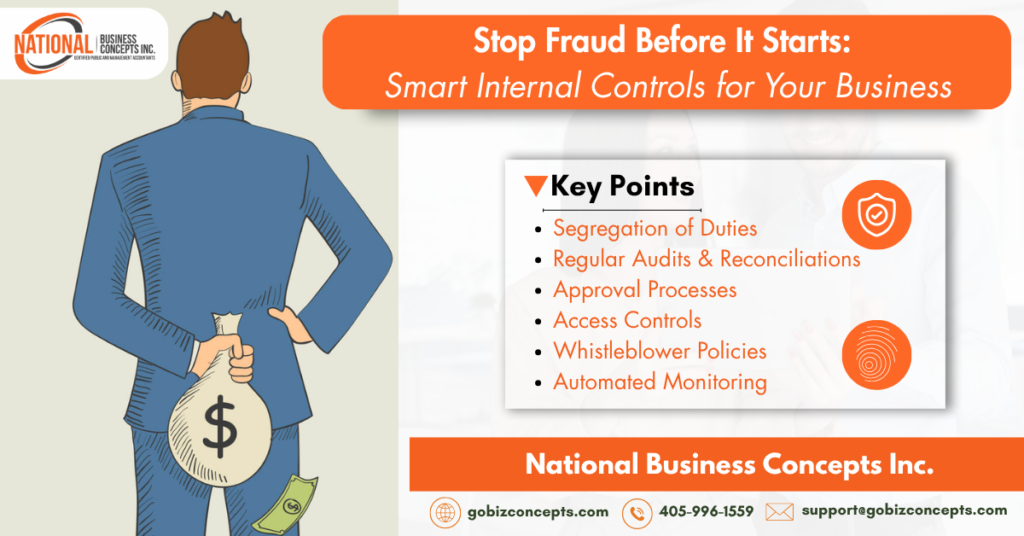
The key components of internal business controls include preventive controls, detective controls, and corrective controls. Preventive controls are aimed at deterring errors or fraud before they occur. Examples include segregation of duties, authorization requirements, and physical access controls. Detective controls are designed to identify and correct errors or irregularities that have already occurred. This includes reconciliations, reviews of performance, and audit trails. And corrective controls are steps that remedy problems found via detective controls. They may involve adjusting journal entries, revising company policies, and retraining staff. Before attempting to implement any type of control, business should consider internal control frameworks.
Frameworks
There are several structured frameworks worth considering. They provide a consistent, risk-based approach. They help ensure controls are not only effective but also aligned with strategic, operational, and compliance objectives. So, there is the COSO Internal Control–Integrated Framework, COBIT (Control Objectives for Information and Related Technologies,) ISO Standards, NIST Frameworks, and the Three Lines Model (formerly Three Lines of Defense,) GRC Frameworks (Governance, Risk, Compliance,) and others. We will attend to some frameworks tailored directly and technically to fraud prevention and detection, due to their pervasiveness, namely Committee of Sponsoring Organisations of the Treadway Commission (COSO,) COBIT (Control Objectives for Information and Related Technologies (COBIT,) and ISO 37001 – Anti-Bribery Management Systems.
COSO
The Committee of Sponsoring Organisations of the Treadway Commission (COSO) framework focuses on enterprise-wide internal controls over operations, reporting, and compliance. Its core components are the control environment, risk assessment, control activities, information communication, and monitoring activities. Each component represents a critical pillar of a sound internal control system. Specific to COSO is its Association of Certified Fraud Examiners (ACFE) Fraud Risk Management Guide that focuses on comprehensive fraud risk management across all types (asset misappropriation, corruption, financial statement fraud, cyber fraud, corruption, asset theft, etc.) Its Core Components of 5 Principles are governance, risk assessment, control activities, investigation, and monitoring. These components work together to help achieve objectives related to operations, reporting, and compliance.
COBIT
Control Objectives for Information and Related Technologies (COBIT) developed by the Information Systems Audit and Control Association (ISACA) focuses on IT governance and management. Its core domains are “Align, Plan and Organize,” “Build, Acquire and Implement,” “Deliver, Service and Support,” and “Monitor, Evaluate and Assess.” These four domains are the management objectives within the COBIT 2019 framework, developed by ISACA to guide effective governance and management of enterprise IT. Each domain represents a distinct phase in the IT value chain, and together they form a lifecycle that aligns IT with business goals, ensures delivery, and maintains oversight.
ISO 37001
International Standards Organisation (ISO) 37001 – Anti-Bribery Management Systems is a globally recognized standard designed to help organizations prevent, detect, and respond to bribery risks. It provides a structured framework for establishing an Anti-Bribery Management System (ABMS) that aligns with international best practices and legal requirements.
Implementation
Effective implementation of internal controls is all about integration, discipline, and culture. It’s not just designing the controls. Also, it’s embedding them into the fabric of daily operations so they’re part of how the business breathes. It is important to begin by performing a risk assessment, i.e., identify, prioritize, and categorize by likelihood and impact key fraud and error risks, based on business type, size, industry, and processes. Design simple and tailored controls for processes by aligning each control with the objective it protects. Segregate duties ensuring that no single individual can initiate, approve, and record transactions or use compensating oversight in smaller organizations. Document policies and procedures by creating standard operating procedures that outline control activities with the assignment of roles and responsibilities and stipulating escalation paths. Conduct periodic training on control procedures and fraud. Communicate the meaning behind each control to gain buy-in and for accountability’s sake. Monitor and audit controls regularly employing exception reports and trend analysis. Audits should test both the design and operating effectiveness of controls. Automate where possible using Enterprise Resource Planning (ERP) workflows, alerts, or Robotic Process Automation (RPA) to enforce controls. Finally, conduct annual or event-driven reviews of controls (e.g., system upgrades, acquisitions, staffing changes,) whilst keeping controls agile and responsive to evolving risks.
Common Fraud Schemes and Prevention Controls
The following is a grid mapping common fraud schemes and the most effective mitigation controls:
|
Fraud Scheme |
Best Internal Control(s) |
Rationale |
|
– Segregation of duties – Reconciliation & audits – Surprise cash counts |
Prevents one person from both handling and recording cash; audits surface discrepancies. |
|
|
Inventory Theft |
– Physical safeguards – Inventory reconciliation – Video surveillance |
Restricts access and verifies actual vs. recorded stock. |
|
Payroll Fraud (Ghost Employees) |
– HR and payroll segregation – Supervisor approval for new hires – Periodic payroll audits |
Prevents unauthorized addition of fake employees; catches anomalies in payment records. |
|
Expense Reimbursement Fraud |
– Managerial approval – Detailed receipt verification – Analytics for duplicates or abnormal claims |
Verifies legitimacy of expenses and flags patterns. |
|
Inflated Revenue Recognition |
– Revenue recognition policies – External audits – Monthly closing reviews |
Enforces accurate timing of revenue and external verification. |
|
Understated Liabilities |
– Reconciliation with vendor and lender statements – Financial review by independent parties |
Compares internal and external records; third-party review provides objectivity. |
|
Asset Overstatement |
– Impairment testing – Inventory aging analysis – Independent valuation |
Detects overvalued or obsolete assets. |
|
Kickbacks / Vendor Collusion |
– Vendor due diligence – Competitive bidding controls – Conflict of interest disclosures |
Ensures vendor selection is legitimate and transparent. |
|
Bid Rigging |
– Rotation of purchasing staff – Dual authorization for procurement decisions – Review of tender processes |
Reduces insider influence over vendor selection. |
|
Phishing & Business Email Compromise |
– Employee cybersecurity training – Multi-factor authentication (MFA) – Alerts on unusual email patterns |
Educates staff on threats and strengthens access control. |
|
Data Theft |
– Access logs and user activity monitoring – Role-based access – Encryption and backup controls |
Limits exposure and helps trace incidents. |
Regulations
Regarding internal controls, businesses need to consider a web of regulations for compliance that vary by jurisdiction, industry, and risk exposure. Amongst them are the Sarbanes-Oxley Act (SOX,) General Data Protection Regulation (GDPR,) Foreign Corrupt Practices Act (FCPA,) EU Anti-Fraud Strategy, Anti-Money Laundering (AML) Directives, UK Bribery Act, and the Financial Action Task Force (FATF) Guidelines. SOX focuses on controls related to financial reporting of U.S. public companies. The GDPR focuses on data protection and breach prevention specifically for organizations handling EU citizens’ data. The FCPA focuses on anti-bribery and accounting transparency. The EU Anti-Fraud Strategy focuses on fraud prevention in EU-funded programs that apply to EU member states and beneficiaries. The AML focuses on money laundering and terrorist financing. The FATF Guidelines focus on global Anti Money Laundering/Countering the Financing of Terrorism (AML/CFT) standards applying to all countries and financial institutions.
Industry Specific Regulations
Industry-specific regulations for banking and finance, healthcare, retail and e-commerce, and digital assets include, respectively: Basel III, Know Your Customer (KYC), Customer Due Diligence (CDD,) and FinCEN rules in the U.S.; Health Insurance Portability and Accountability Act of 1996 (HIPAA) (U.S.); Payment Card Industry Data Security Standard (PCI DSS); and AML/CFT rules, specifically for non-fungible token (NFTs) and decentralized finance (DeFi) Platforms.
Conclusions
To prevent fraud, businesses must establish reliable internal controls—rules and procedures that ensure accurate financial reporting, encourage accountability, and reduce risk. These controls, including preventive, detective, and corrective measures, combat threats like embezzlement, payroll fraud, and data theft. Choosing a framework like COSO or COBIT provides structure, especially when integrating governance and IT processes. Effective internal controls are not only designed but woven into daily operations, guided by risk assessments tailored to the business’s size, industry, and exposure. Companies must also navigate compliance requirements across jurisdictions. Regular internal audits verify that controls function properly and support sound governance. Despite varying designs, key principles of internal controls have become essential to modern business management.
